


Most B2B marketing teams didn’t set out to build a fragmented tech stack. It happened gradually. Email platform here. Social scheduler there. Paid media dashboard somewhere else. Then AI tools came along promising to make everything easier. And for a while, it seemed like they might.
Except they didn’t. Not really.
What happened instead was a new kind of overhead: briefing AI tools that don’t know your customers, copying context between a dozen tabs, and correcting outputs that hallucinated details your CRM already had. The more tools teams added, the more time they spent managing the tools instead of running the campaigns.
HubSpot’s CMO Kipp Bodnar has a name for it: the productivity paradox. And HubSpot Marketing Studio is their answer to it.
Key takeaways:
- Most B2B marketing teams are spending significant time managing tools rather than running campaigns
- Marketing Studio brings web, social, paid, and email together in one place inside HubSpot, on a Marketing Hub Professional or Enterprise licence
- Three AI agents — Campaign Agent, Content Agent, and Nurture Agent — work from your existing CRM data, not a blank slate
- The further along a company is in its AI journey, the more likely it is to be hitting its marketing targets, by a wide margin
- Concentrate specialises in Marketing Hub implementation and team enablement to get you live and confident faster
The productivity paradox, and why more tools aren’t the answer
Kipp Bodnar (HubSpot CMO) put it plainly: the teams breaking out of this cycle are “the ones running tools that already know their business when they open them.”
That’s the crux of it. The problem with most marketing AI isn’t the AI itself, rather it’s the context gap. When a tool doesn’t know your customers, your brand, your past campaign performance, or what’s worked before, you have to feed it all of that every single time. That’s not a productivity gain. It’s just a different kind of manual work.
The data backs this up. According to HubSpot’s State of AI in Marketing report, 72% of marketers say AI makes it easier to hit revenue goals and MQL targets. But the results aren’t evenly distributed. Companies that are further along in their AI journey (what HubSpot calls “transformational adopters”) are hitting their targets at much higher rates than those still at the early stage.
96% of transformational adopters are at or above MQL targets, compared to 74% at early stage.
The difference isn’t which AI tools they’re using. It’s how well integrated those tools are with the rest of how they work.
What is HubSpot Marketing Studio?
Marketing Studio is HubSpot’s all-in-one marketing execution environment. It brings web, social, paid, and email together so teams can plan, build, run, and measure connected campaigns from a single place, inside the same platform where your CRM already lives.
It’s available on Marketing Hub Professional and Enterprise licences. If you’re already on either of those tiers, the tooling is there waiting to be used!
The point isn’t consolidation for its own sake. It’s that when your marketing channels share the same data and the same customer context, everything works better. Segmentation is more precise. Attribution is clearer. The handoff between marketing and sales stops being hard to see and manage.
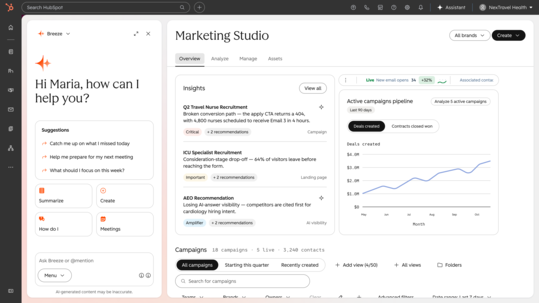
Image: HubSpot Marketing Studio
Web. Social. Paid. Email. Together in one place.
At its core, Marketing Studio connects the channels B2B marketers use every day:
-
Web: your HubSpot CMS or connected site, smart content, landing pages, and CTAs
-
Social: publishing, scheduling, and engagement tracking
-
Paid: ad management across Google, Meta, and LinkedIn, with attribution tied back to your CRM. HubSpot also supports TikTok and ChatGPT ads
-
Email: full email marketing and automation built on your contact and engagement data
HubSpot’s research shows 35% of marketers have implemented AI strategies in email and newsletters , which makes it the single most common AI use case — with 32% doing the same in online advertising and social. Marketing Studio is built specifically around the channels where AI adoption is already happening.
The difference from a traditional marketing suite is that all of this shares the same contact records, lifecycle stages, and interaction history. You’re not exporting to a spreadsheet to see the full picture.
The AI agents that know your business
Here’s where Marketing Studio changes the game. Three context-aware AI agents work inside the platform, and unlike generic AI tools, they start with the customer data you’ve already got in HubSpot.
Campaign Agent helps you plan, execute, and measure campaigns. Rather than starting from a blank brief, it works from your CRM data, past performance, and customer history to help you build campaigns grounded in what’s already worked.
Content Agent turns recommendations into ready-to-publish content such as blog posts, LinkedIn updates, and social content, all using your brand, audience context, and goals. Because it draws on your HubSpot data, it’s not producing generic output that we are all used to seeing out of non-contextual AI sources.
Nurture Agent (currently in beta) handles the follow-up. When a lead engages, Nurture Agent builds on the context in your CRM to keep outreach relevant, without requiring your team to manually sequence every touchpoint.
Together, these agents don’t replace your team’s thinking. They reduce the time between having a strategy and having it live.
HubSpot’s research found that speed and agility is the number one performance gain marketers attribute to AI — cited by 27% of marketers as their top result.
Why the CRM connection is the real differentiator
Most standalone marketing tools treat your CRM as an afterthought. Marketing Studio is built on top of the CRM. The customer data isn’t imported - it’s native.
That means when Campaign Agent makes a recommendation, it’s not guessing at your audience. When Content Agent writes a follow-up email, it knows the contact’s lifecycle stage, their industry, and what they’ve engaged with before. When Nurture Agent sequences outreach, it can personalise based on real deal history, not a static list segment.
For B2B teams, where sales cycles are long and relationships matter. this is a meaningful difference. It also keeps marketing and sales working from the same page. The contact record your sales team is working from is the same one your marketing campaigns are running against. No more “are they already in a deal?” No more leads falling through the gap between platforms.
You shouldn’t need a technical expert just to run a campaign
One of HubSpot’s explicit design goals with Marketing Studio is that teams shouldn’t need deep technical expertise to get campaigns live. Built-in guidance, HubSpot Academy resources, and Breeze AI support are there to reduce the gap between having a strategy and having it running.
This matters especially for smaller marketing teams — often one or two people — who are expected to own web, social, paid, and email without dedicated specialists for each area. Marketing Studio is designed to give those teams a platform that handles the complexity without requiring them to become technical experts in every channel.
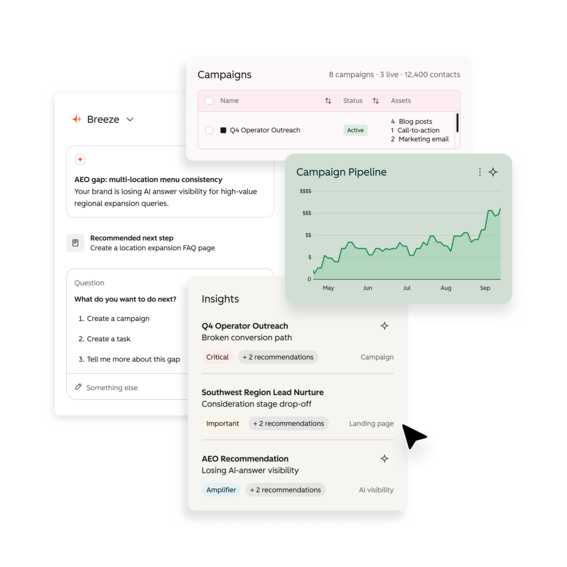
Image: HubSpot Marketing Studio
Our take
We work with B2B marketing teams across ANZ at every stage of their HubSpot journey, from teams setting up for the first time, to those who’ve been in the platform for years and want to get more from it.
Recently, we helped an aged care provider in Australia bring their marketing activity into HubSpot, with a focus on social and email. Before the project, activity was spread across separate tools with no shared view of what was happening across channels. After implementation, the team had full visibility across their marketing activity, management got consolidated reporting, and the whole operation became something they could actually measure and build on.
That’s the shift Marketing Studio makes possible, but it doesn’t happen automatically. Getting your portal configured properly, connecting your channels, setting up your agents with the right context, and enabling your team to use the tools in their daily workflow is where the value gets unlocked.
That’s exactly what we help with.
Ready to get Marketing Studio set up?
If you’re evaluating Marketing Studio, or you’re already on Marketing Hub Pro or Enterprise and want to make more of what you’ve got, talk to our team. We’ll work with you on what’s needed to get properly set up and get your team running confidently.
And if you want to understand where AI fits into the wider B2B marketing picture, HubSpot’s State of AI in Marketing report is worth a read. It’s free and gives solid context for where teams are heading.